
THE technological education for children It is no longer a trend of the future — it is a reality that transforms the present.
Advertisements
In recent years, teaching programming to children has proven to be a powerful tool not only for cognitive development, but also for developing skills essential to the modern world.
So, let's explore how introducing technology into early childhood education can benefit children's intellectual, social and emotional growth, highlighting important areas such as problem-solving, logical thinking and creativity.
The Role of Programming in the Formation of Critical Thinking
Teaching kids to code promotes critical thinking in a practical and engaging way.
By creating code, children learn to solve problems by breaking them down into smaller parts and analyzing logical solutions.
According to a study conducted by the Massachusetts Institute of Technology (MIT), students who learned programming from an early age had a 20% increase in problem-solving skills compared to those who followed a conventional education.
This ability to break down complex problems into manageable steps encourages analytical thinking.
However, children learn to approach seemingly impossible questions with a structured method, which is reflected in other school subjects and in everyday life.
Furthermore, this process improves mental organization, facilitating the understanding of complex concepts in different areas.
The program also encourages persistence in the face of challenges.
An error in a code, for example, is an opportunity to teach resilience, a skill that is increasingly valued in a competitive job market.
By dealing with mistakes constructively, children develop skills to overcome difficulties in other aspects of life, such as school projects or complex social interactions.
+ The Best IT Certifications to Stand Out in the Job Market
Emotional and Social Benefits of Technological Education
Another important aspect is the social and emotional impact.
When children work on collaborative programming projects, such as creating games or animations, they consequently develop teamwork skills.
They learn to share ideas, as well as deal with different perspectives and resolve conflicts constructively.
This interaction strengthens skills such as empathy and effective communication.
Furthermore, technological education can contribute to self-esteem.
Therefore, completing a programming project, such as building a simple robot or creating an interactive story, creates a sense of accomplishment that motivates children to seek out new challenges.
This sense of achievement, however, builds confidence and helps build a positive mindset towards learning.
Another relevant point is the promotion of autonomy.
Coding encourages children to explore solutions on their own, and in doing so, increases their sense of independence.
So, when faced with problems, they become more likely to proactively seek alternatives, developing an initiative profile that will be essential in their academic and professional trajectories.
These learnings are also reflected in family interactions.
Parents and children can collaborate on technology projects, strengthening bonds and creating meaningful moments of connection.
Ultimately, this enriching experience contributes to a more harmonious and educational family environment.
Skills Developed with Programming
1. Computational Thinking
This skill is the basis for solving complex problems.
Through decomposition, patterns and abstraction, children learn to plan solutions in a structured and efficient way.
One of the advantages of computational thinking is its application in several areas.
Children who master this skill can use it to solve math problems, perform scientific experiments, and even deal with everyday situations, such as organizing tasks or planning activities.
This approach also encourages creativity in problem-solving.
By exploring different ways to achieve a goal, children develop cognitive flexibility, which is essential for adapting to ever-changing scenarios.

2. Creativity
Technological projects stimulate the imagination.
For example, when programming a game, the child decides the characters, the setting and the narrative, integrating logic and art into a single project.
This creativity can also be applied to interdisciplinary projects.
For example, a child might use programming to create interactive stories that combine literary knowledge with technological skills.
This type of activity is an innovative way of integrating different areas of knowledge.
Creative freedom also encourages innovative thinking.
Children who learn to create original solutions in programming tend to develop valuable skills for the future, such as design thinking and technological innovation.
See also: 7 Essential Tools for Web Developers
3. Digital Literacy
Understanding how technology works prepares children for a society where digital skills are indispensable.
This knowledge goes beyond the use of applications, enabling them to create and modify technological solutions.
This literacy also helps children understand the risks and benefits of technology.
By learning about digital security and privacy, they become more aware and responsible users, contributing to a healthy relationship with the online environment.
Additionally, digital literacy opens doors to future technology careers.
Children who develop these skills early are more likely to explore areas such as software development, game design and cybersecurity in the future.
| Ability | Description |
|---|---|
| Computational Thinking | Solve problems with decomposition and analysis techniques. |
| Collaboration | Work as a team to achieve goals. |
| Creativity | Develop innovative and customized solutions. |
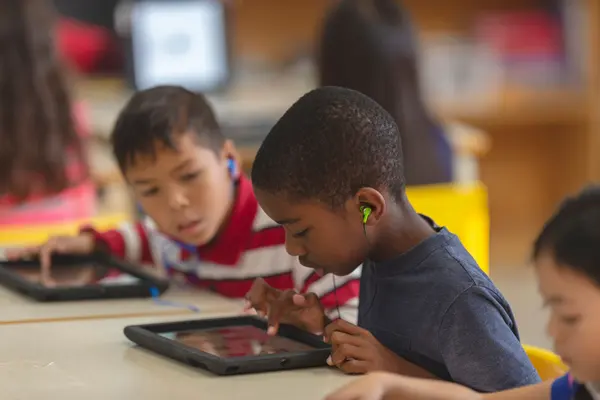
Resources and Platforms for Introducing Technology to Early Childhood
There are several platforms that make technology learning accessible and fun.
Tools like Scratch, Tynker and Code.org use visual programming languages to teach basic concepts in a fun way.
Additionally, robotics kits such as LEGO Mindstorms and Arduino, allow kids to see their codes come to life on real machines.
These platforms are designed to suit different age groups, ensuring that learning is progressive and adapted to each child's level of understanding.
This allows even the youngest children to explore the world of technology in a safe and fun way.
Another advantage of these tools is the possibility of learning through experimentation.
Kids can test ideas, correct mistakes, and refine their creations, which encourages a growth mindset.
This approach also makes learning more meaningful as children see the direct impact of their efforts.
These resources also help parents participate in the educational process, creating moments of family connection while exploring the world of technology together.
Parental presence not only encourages children's interest, but also strengthens family bonds through collaborative activities.
Programming as an Inclusion Tool
THE technological education for children also plays a crucial role in promoting inclusion.
By providing equal learning opportunities, girls and boys can develop interest and competence in areas previously dominated by a single gender.
According to UNESCO, initiatives that encourage female inclusion in technology have doubled the number of girls interested in STEM careers (Science, Technology, Engineering and Mathematics).
Promoting inclusion in technology also contributes to the diversity of ideas and solutions.
Children from different backgrounds, when exposed to the world of programming, bring unique perspectives that enrich the educational environment and encourage creative collaboration.
Another advantage is the creation of a more egalitarian learning environment.
When technology education is implemented in an inclusive way, all children, regardless of gender, social class or location, have the opportunity to explore their talents and develop their potential.
How to Integrate Technology Education at School and at Home
Integrating technology doesn't have to be complicated.
In schools, interdisciplinary projects can unite science and arts through technological tools.
At home, parents can encourage the use of educational platforms and support initiatives such as children's hackathons.
An effective way to integrate technology is through hands-on activities.
For example, teachers can create coding challenges that encourage students to solve real-world problems, such as developing solutions to reduce energy waste at home.
Parents can also transform everyday moments into technological learning opportunities.
Cooking a recipe together can become a lesson in sequence of steps, similar to the concept of algorithms.
This type of approach transforms learning into something practical and engaging.
| Strategy | Example |
|---|---|
| Interdisciplinary Projects | Create interactive stories mixing arts and IT. |
| Gamified Learning | Using educational games to teach programming. |
| Free Exploration | Encourage experimentation on open platforms. |
Conclusion
THE technological education for children represents a transformative learning opportunity that goes beyond the acquisition of technical skills.
By promoting creativity, critical thinking and collaboration, it prepares children to face the challenges of a digital future in a confident and creative way.
Introducing coding at an early age is not just about training future programmers, but about empowering children with the tools to be problem solvers, innovators, and global citizens prepared to lead in the 21st century.
